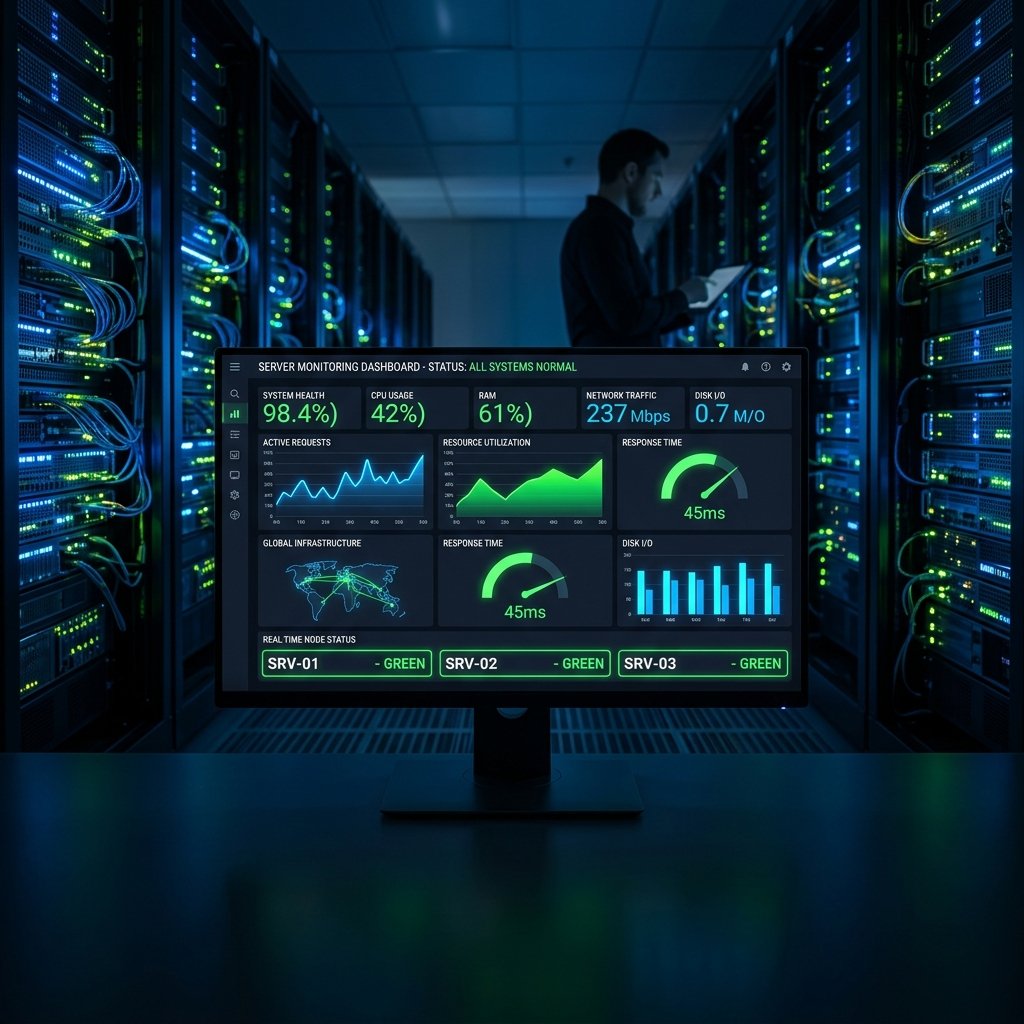
One hour of enterprise-level downtime in 2026 costs an average of $300,000. For midsize businesses, a single minute of outage can burn through $14,000 in lost productivity, transaction failures, and immediate customer churn. Monitoring uptime is no longer a peripheral background task for SysAdmins. It is the primary financial barrier between your digital infrastructure and operational collapse.
You cannot manage what you do not measure with surgical precision. Every second your server remains unresponsive is a second your competitors gain market share while your brand equity erodes. High-velocity businesses require more than a binary "up or down" confirmation. They require a deep-dive analysis of connection health, latency distribution, and protocol integrity to ensure that the user experience remains flawless globally.
The Financial Reality of Downtime in 2026
The cost of unplanned outages has escalated dramatically as businesses become deeply integrated with complex cloud microservices and real-time data pipelines. According to recent 2026 industry reports, the median cost of downtime for medium-sized organizations is now $14,000 per minute. For large-scale enterprises with heavy transaction volumes, this figure surges to $23,750 per minute. This calculation includes direct revenue loss and the massive hidden costs of idle staff time.
Beyond the immediate ledger impact, long-term reputational damage is often the most devastating consequence of poor uptime management. Search engines and performance-monitoring algorithms penalize slow or frequently down servers by lowering their organic ranking and quality scores. This means a single major outage doesn't just kill today's sales. It throttles your customer acquisition pipeline for weeks as you struggle to regain established SEO positions and user trust.
Service Level Agreements (SLAs) are the benchmark for technical accountability in professional infrastructure management. A common target is "Three Nines" (99.9%), which seems high but allows for a staggering 8.77 hours of downtime per year. If your business handles mission-critical data, you likely need to target "Five Nines" (99.999%), reducing allowed downtime to a mere 5.26 minutes annually. Achieving this level of reliability is impossible without sub-60-second monitoring resolution.
Therefore, you must transition from reactive troubleshooting to pro-active infrastructure observability. Every dollar invested in high-resolution monitoring acts as insurance against catastrophic failure. By detecting a performance degradation before it becomes a complete service outage, you can trigger automated failover mechanisms or manual interventions that preserve your SLA and your bottom line.
Anatomical Breakdown of an Uptime Check: From DNS to HTTP
A professional uptime check is not just a simple "ping" command executed from a remote server. It is a multi-layered verification process that mimics the exact path a user's browser takes when attempting to access your application. Understanding this anatomy allows you to identify exactly where a connection is failing. The process begins with **DNS Resolution**, where the monitor resolves your domain name to an IP address across global name servers.
Once the IP is identified, the monitor initiates the **TCP Three-Way Handshake** (SYN, SYN-ACK, ACK). This step verifies that the network layer is functional and that the target port (usually 443 for HTTPS) is accepting traffic. If the handshake fails, you know the issue is likely related to firewall misconfigurations, routing problems, or a crashed service process on the server itself. This level of granularity is vital for isolating network-level bottlenecks from application-level bugs.
[TEXT]
For secure connections, the monitor then performs a **TLS Handshake** (specifically TLS 1.3 in 2026). During this phase, it verifies certificate validity, expiration dates, and encryption negotiation. A failed TLS check often signals a soon-to-expire certificate or a man-in-the-middle vulnerability. By monitoring this layer, you prevent one of the most common causes of "silent" downtime: users reaching your server but being blocked by browser-level security warnings.
[TEXT]
The final layer is the **HTTP Request/Response cycle**, where the monitor evaluates the **HTTP Status Code**. A status code of 200 OK confirms success, but codes like 503 (Service Unavailable) or 504 (Gateway Timeout) indicate deep backend failures. Uptime4 allows you to verify specific string presence in the response body, ensuring that your server isn't serving a "Success" code while actually displaying a "Database Connection Error" white page to your users.
[HEADING H3]
Using Uptime4 API for Granular Checks
[TEXT]
Automating your monitoring infrastructure is essential for scaling operations. You can create a new monitor via our REST API with a simple CURL command to ensure every new server is covered instantly.
[HEADING H2]
Why 60-Second Resolution is the New Industry Minimum
[TEXT]
The resolution of your monitoring determines your **Mean Time to Detection (MTTD)**. Many legacy services still offer 5-minute or even 10-minute check intervals by default. This creates a massive blind spot where your server could be down for nearly 300 seconds before a single alert is dispatched. In a high-traffic environment, a 5-minute gap is an eternity that can lead to thousands of failed transactions and a total loss of user confidence.
[TEXT]
Uptime4 implements **1-minute monitoring** as the foundational standard for all production-grade checks. This high-resolution data allows you to see oscillating failures (flapping) that a 5-minute monitor would simply miss. By capturing short-lived micro-outages, you can diagnose underlying issues with load balancers or database connection pools before they escalate into persistent, long-term downtime. This proactive approach is the hallmark of a mature DevOps culture.
[TEXT]
Furthermore, high-resolution monitoring allows for more accurate **SLA Reporting**. When your checks occur every 60 seconds, your uptime percentage reflects the actual user experience with much higher fidelity. You can provide your clients and stakeholders with verifiable data showing that your infrastructure is truly resilient. This transparency builds credibility and allows you to command higher price points for your enterprise-level managed services.
[TEXT]
Consequently, switching from 5-minute to 1-minute intervals is the single most effective way to optimize your incident response. It gives your technical team the "early warning" needed to scale up resources or redirect traffic before the impact reaches your end-users. In the world of infrastructure, speed is not just a preference. It is the primary metric that determines whether your business survives a sudden traffic surge or a hardware failure.
[HEADING H2]
Mastering Multi-Channel Alerts: WhatsApp, Voice, and SMS
[TEXT]
Detecting an outage is only half the battle. If your notification system is siloed in a crowded email inbox, your detection speed is rendered useless. Notification fatigue is a real risk for technical teams who receive hundreds of non-critical system emails daily. To protect your MTTR (Mean Time to Repair), you must implement a "Tier 1" alerting strategy that uses high-priority channels for mission-critical failures.
[TEXT]
Uptime4 provides native integration with **WhatsApp**, **SMS**, and **Direct Voice Calls**. These channels are significantly harder to ignore than an email or a standard Slack message. A WhatsApp alert pops up directly on a developer's phone with an urgent tone, ensuring that the person on-call is aware of the situation within seconds. For critical business hours, a direct voice call ensures that even if a team member is away from their screen, the incident is acknowledged immediately.
[TEXT]
You should also implement **Escalation Policies** to ensure accountability across your organization. If the primary responder does not acknowledge a WhatsApp notification within 5 minutes, Uptime4 can automatically escalate the alert to a secondary team member or a manager. This ensures that no incident goes unaddressed due to human error, such as a phone being on "Do Not Disturb" mode or a responder being temporarily unavailable.
[TEXT]
Therefore, your alerting strategy should be as resilient as your server infrastructure. By diversifying your notification channels and using high-visibility platforms like WhatsApp, you eliminate the delays that turn a minor glitch into a prolonged outage. This ensures that your response team is always one step ahead of the incident, maintaining the high availability that your customers expect and your business requires to thrive.
[HEADING H2]
Conclusion: Setting the Standard for Availability
[TEXT]
Infrastructure reliability in 2026 is a multi-dimensional challenge that requires local presence, high-resolution data, and unignorable alerting. By monitoring your servers every 60 seconds from nodes strategically located in Milan, Rome, and across the globe, you gain the technical insight needed to defend your revenue. Uptime4 offers the tools to bridge the gap between simple up/down checks and a comprehensive observability strategy that protects every layer of your stack.
[TEXT]
Don't let a blind spot in your monitoring become a financial liability. Take control of your infrastructure today by setting up your first high-resolution monitor. With direct WhatsApp alerting and deep protocol analysis, you'll be the first to know when things go wrong and the first to restore service, keeping your business running at the speed of the modern web.
[DELIMITER]
[BUTTON]
Start Monitoring with Uptime4 Now
---
slug: server-uptime-monitoring
title: Server Uptime Monitoring in 2026: Protection Guide
description: Deep dive into server uptime monitoring. Learn about DNS, TCP, and TLS layers, and how to reduce MTTR with 1-min intervals and WhatsApp alerts.
icon: fa-server
lang: en
type: blog
funnel: middle
intent: commercial
keywords:
- server uptime monitoring
- downtime cost 2026
- MTTR optimization
- TCP three-way handshake
- TLS 1.3 verification
- SLA compliance
- WhatsApp alerts
- latency monitoring
- IT infrastructure observability
updated: 2026-04-21
canonical: https://uptime4.com/blog/server-uptime-monitoring/
---